Table of Contents
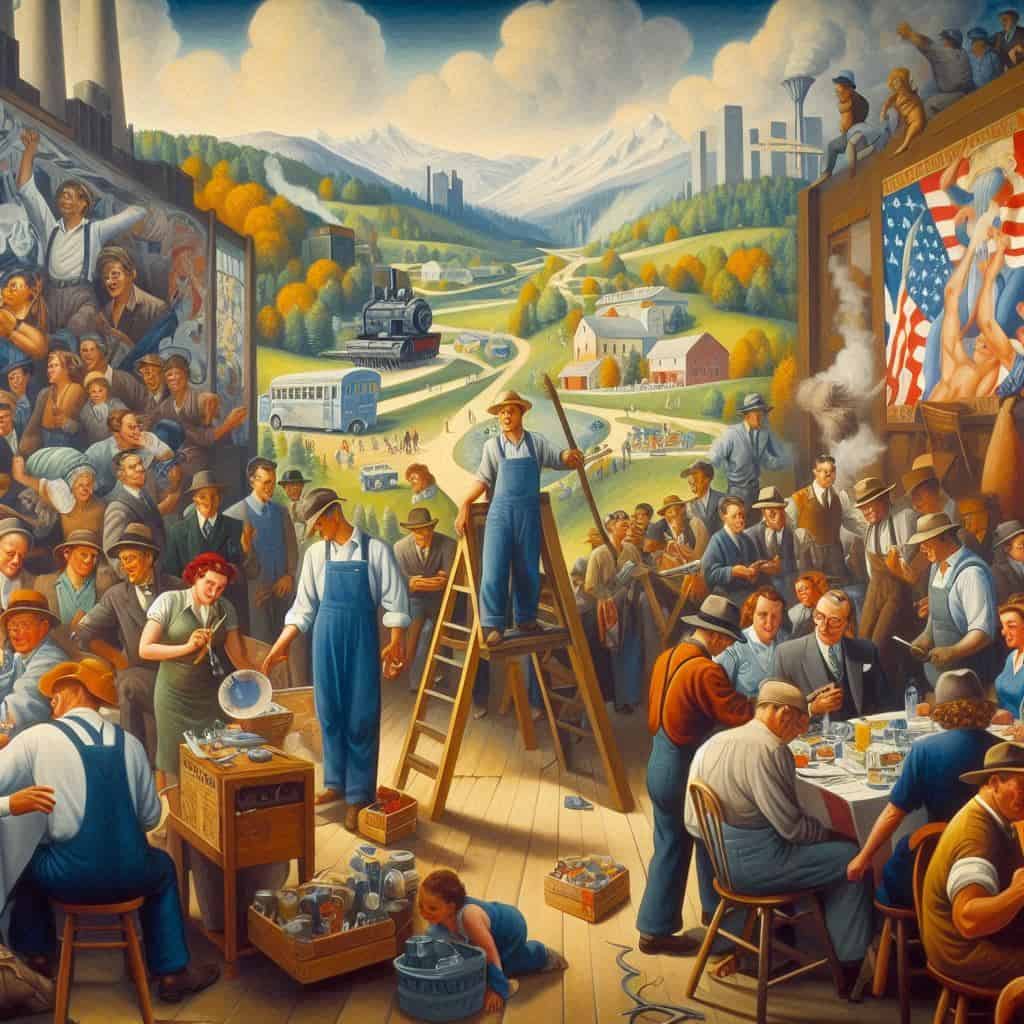
In the winter of 1934, America was gripped by the devastating effects of the Great Depression. Unemployment hovered around 25 percent, families struggled to survive, and February marked the coldest month on record in the Northeastern United States. As the country grappled with despair, a bold government initiative began to shift not only the economic outlook but also the cultural landscape: the introduction of federally-funded art through what would become known as New Deal Art.
Feeding the Soul: The Start of the Public Works of Art Project (PWAP)
With the rollout of the Federal Emergency Relief Act, early New Deal programs started providing jobs to desperate Americans. But a unique question emerged: should artists be included among those offered work relief? At the time, it wasn’t an obvious decision—after all, artists typically didn’t have conventional “jobs” to lose. Still, Harry Hopkins, President Franklin D. Roosevelt’s close adviser, made the call with memorable clarity: “Hell, they’ve got to eat just like other people!”
Thus, the Public Works of Art Project (PWAP) was born—the first federal program to fund visual arts. Over just four months in 1934, the PWAP hired 3,749 artists who produced more than 15,000 works, including murals, paintings, prints, crafts, and sculptures, all destined for public buildings across the country.
Numbers and Impact: Art as Public Work
The federal government tracked the program closely. While they gave minimal guidance on subject matter, they meticulously counted output and payment: a total of $1,184,000 was distributed, averaging about $75.59 per artwork. Even by Depression-era standards, this was seen as high value for money.
The key premise behind New Deal Art was that artists, like manual laborers, should contribute tangible, valuable work to the public good. Instead of digging ditches or building roads, they were tasked with beautifying public spaces and capturing the American experience on canvas.
Recruiting America’s Artists
Artists were recruited through nationwide newspaper advertisements. Applications flooded in, with aspiring contributors lining up in freezing weather to prove they were professionals. According to George Gurney, deputy chief curator at the Smithsonian American Art Museum, applicants were required to pass a needs test and were categorized into salary tiers—Level One Artist, Level Two, or Laborer.
The PWAP wasn’t intended to discover the next Mark Rothko or Jackson Pollock (though those names would later be linked with the Works Progress Administration, or WPA). Instead, it showcased artists who, while now relatively unknown, were vital contributors to a defining moment in American art history.
Another Article : What’s the Deal with New Deal Art?
Forgotten Names, Timeless Work
Elizabeth Broun, director of the Smithsonian American Art Museum, notes that many artists featured in PWAP’s programs were under 40 and hadn’t yet gained national recognition. Their works may have faded from collective memory, but they left a lasting impact. Without the Smithsonian’s archival efforts in the 1960s, many PWAP pieces might have been lost forever.
“These artists did their best work for the nation,” Broun states, “and then disappeared below the national horizon, into the realm of regional or local artists.” This statement speaks to a deeper truth about New Deal Art—its power came not from fame but from community, resilience, and a sense of national identity during hard times.
Painting the American Scene
The federal government offered minimal instruction on what to paint, merely suggesting that the “American scene” would be a suitable subject. Artists embraced this directive enthusiastically. The result was an expansive visual record of American life during the Depression.
Landscapes, cityscapes, and industrial scenes became staples of New Deal Art. Harbors, coal mines, paper mills, and ironworks filled canvases, often painted in stark, dramatic tones. While some pieces romanticized rural life, others, like Earle Richardson’s Employment of Negroes in Agriculture, offered stylized interpretations that suggested the artist’s limited exposure to actual farm labor.
Art as a Mirror of Resilience
Though not documentary in nature, these artworks painted a collective image of a country in flux—but not in collapse. They showed that even with a quarter of the nation unemployed, life continued for the other three-quarters. Harry Gottlieb’s Filling the Ice House captures men working in wintry New York. Morris Kantor’s Baseball at Night showcases communal leisure. Daniel Celentano’s Festival buzzes with East Harlem life—music, religion, food, and movement.
These were images of a people adapting, surviving, and even thriving amid uncertainty.
Subtle Messages and Unspoken Politics
One of the compelling aspects of New Deal Art was its subtlety. While overt political commentary was rare, underlying themes emerged when paintings were placed side-by-side. Consider Jacob Getlar Smith’s Snow Shovellers, depicting weary men earning pennies to clear parks, versus Gerald Sargent Foster’s Racing, which shows affluent men leisurely sailing on Long Island Sound. The contrast is striking, even if unintentional.
A particularly progressive painting for its time was Lily Furedi’s Subway, featuring New Yorkers of multiple races and social classes sitting together. While the subway was devoid of graffiti or litter, the social mix was authentic, raising questions about how legislators of the era would have responded to racially inclusive government-funded art.
From Optimism to Legacy
The exhibition at the Smithsonian, planned long before the 2008 financial crisis, coincidentally opened during another time of economic anxiety. The nostalgic tone of New Deal Art—the hope, the community, the resilience—felt particularly poignant.
In a time when American industry still held a promise of rebirth, these paintings envisioned a future that could be rebuilt by hard work and civic pride. The question arises today: what would “the American scene” look like to modern artists? Would it be overgrown subdivisions, decaying strip malls, or Amazon warehouses?
Why New Deal Art Still Matters
The enduring relevance of New Deal Art lies in its core message: that even in times of crisis, creativity has a place. That government can support not just roads and bridges, but also imagination, beauty, and shared culture.
It challenges us to reconsider what public investment in the arts can look like—especially in difficult times. Art not only preserves history; it uplifts communities, fosters empathy, and ignites progress.
Also Read : NY Times


Leave a Reply